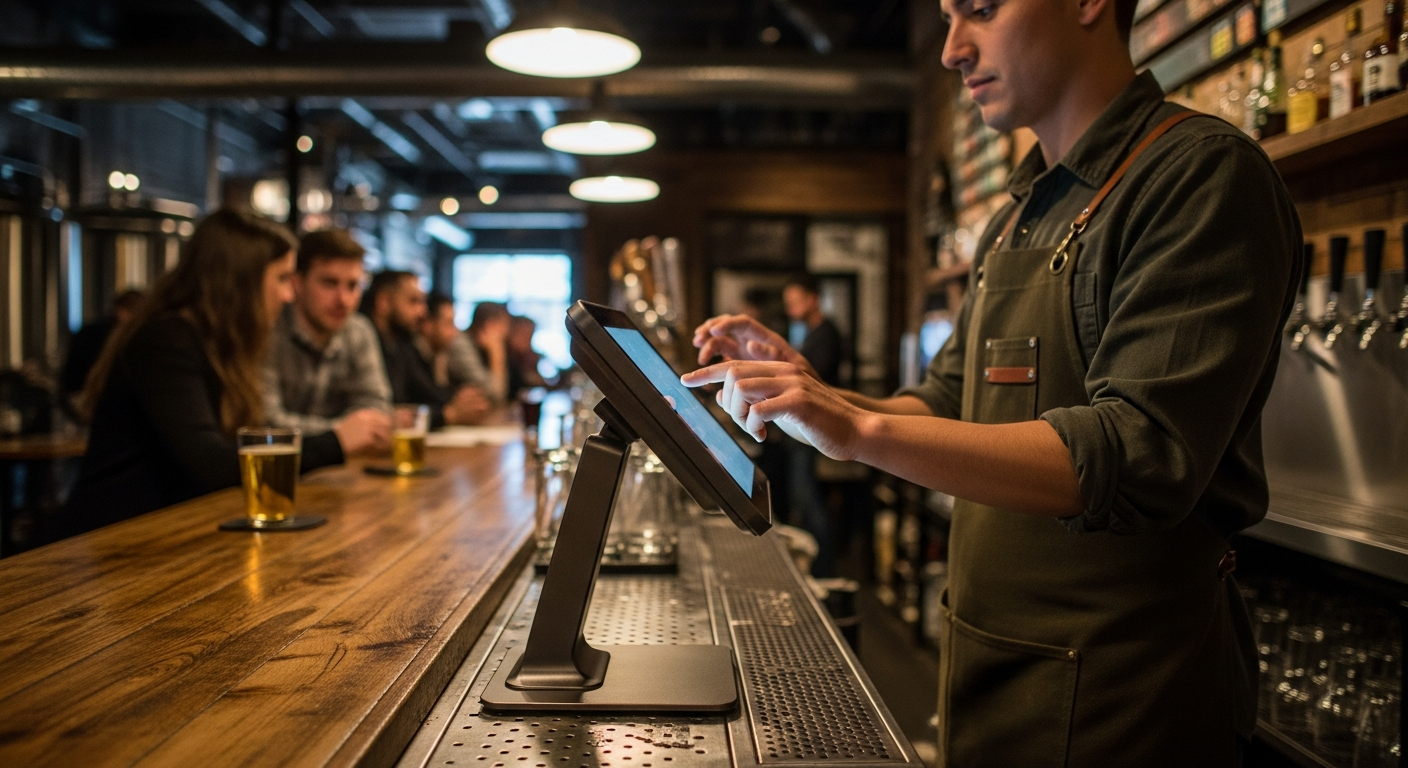

Image generated by Gemini
Patios are filling up again, and now, the issue at the forefront of taproom owners’ minds is how to provide consistent service, quality, and efficient operations during peak hours. Is your point-of-sale system up to the challenge of Saturday rush?
| Name | Pros | Cons | Pricing |
| SpotOn | Rugged, spill-resistant hardwareTrue offline mode for network dropsDeep draft monitoring integrations | Custom pricing requires a sales callMay be feature-heavy for nano-breweries | Custom / starting at $0/mo + transaction fees |
| Arryved | Tab-centric mobile workflowBuilt specifically for craft beveragesNo large monthly software fees | Limited to approved Android hardwareRevenue model tied to processing volume | Pay-per-transaction based |
| Square | Very affordable to startStrong omnichannel and online toolsFamiliar brand for guests | Generic restaurant features, not brewery-nativeTransaction fees add up at high volumes | $0/mo standard + transaction fees |
| Lightspeed | Advanced inventory and ingredient trackingBuilt-in AI assistantMulti-location capabilities | Can be complex to set upHigh learning curve for simple operations | Custom bundled pricing |
| Tabski | Great for food-hall style campusesAutomated multi-vendor payoutsSolid QR ordering for large patios | Overkill if you don’t host external food vendorsSetup fees apply for complex routing | $69/mo per terminal |
| CrumblePOS | Ideal for brewery food trucksIncluded KDS and online orderingSeasonal pause billing options | Not designed for massive indoor taproomsSmaller integration marketplace | $89/mo per device |
The stakes for independent PNW breweries are higher than they were even a few years ago. When you’ve got a line out the door for your latest fresh hop release, a frozen screen or crashed network can derail the whole afternoon. Margins are tight across hospitality, and every pint poured counts.
Industry data shows that brewery closings outpaced openings by nearly 2-to-1 over the past year. Plus, transportation costs for ingredients and packaging have surged by 15 to 25 percent, eating directly into profitability. Upgrading your POS setup isn’t a luxury anymore; it’s a survival move.
A good point of sale system should be the nerve centre of your operation and provide you with business intelligence to help you identify and eliminate slow food, and prevent “wall-time” that impacts the kitchen without adding margin. Real-time inventory visibility means inventory always reflects the current state of the business, and purchase order suggestions are made based on the real velocity of the items being sold, not on what we assume sales will be.
Sound familiar? The closure of Anchor Brewing in San Francisco was a stark reminder of the pressure the industry faces. The Brewers Association logged 385 closures in 2023 alone. The old pricing model is cracking, with major brewers no longer able to lean on constant price hikes. The takeaway for independents? Get your staff the right digital tools, and get them fast.
What to Look for in a Taproom POS
Before jumping into the top picks, it helps to know what separates a generic restaurant register from a true brewery-ready system. A standard retail setup will stumble when a guest orders a hazy IPA flight, adds a warm pretzel, leaves their card at the bar, and wanders out to the beer garden. Modern taprooms require specialized features designed for high-volume beverage service and complex floor plans. A reliable offline mode is non-negotiable. Cloud-only systems risk latency during peak checkout, resulting in lost sales. Below are the platforms that were tested on hardware durability, offline, and craft-specific workflow. You don’t want to experience the expensive implementation error later and need to remember those requirements.
The Best Systems for Pouring Pints
The tech environment in the hospitality industry continues to evolve. In fact, DoorDash recently rolled out new standards for restaurant POS integration with an aim to make restaurant performance better. For instance, DoorDash recently came out with new POS integration standards for better restaurant performance, which is a sign of the widespread drive for seamless restaurant integration. Operators demand platforms that eliminate wrong menus, reduce order cancellation
SpotOn

For managing large crowds and complex floor plans, the Brewery POS system from SpotOn is a top pick for high-volume taprooms. SpotOn is a software and payments company that’s built a strong reputation for the kind of technology local businesses actually need. Rather than cramming a generic restaurant template onto a brewhouse, they’ve adapted their hospitality platform to match how a busy taproom actually runs. Their suite includes SpotOn Reserve, which manages traffic and waitlists during packed weekend events, and their Teamwork labor tools make hitting labor targets easier by building schedules off real sales data.
That unified approach means you don’t have to stitch together a bunch of incompatible third-party software. What really sets SpotOn apart is its durable hardware, paired with an enterprise-grade offline mode. If your internet goes down during a fresh hop release party, the system keeps processing orders, syncing kitchen display screens, and storing payments locally. SpotOn also plugs directly into draft monitoring tools like US BeerSAVER and DigitalPOUR, so you can track keg yields and reduce shrinkage. Their Station 15 hardware and rugged handhelds are built to handle beer spills and sticky fingers. Combine that with image-based beer menus and profitability analysis, and you’ve got a taproom that hums.
| Feature | Details |
| Key product | SpotOn Restaurant POS for breweries |
| Main benefit | Enterprise-grade offline mode, durable hardware |
| Target audience | High-volume taprooms, multi-location breweries |
| Price range | Starting at $0 upfront + transaction fees |
Arryved

Born out of the Colorado craft beer scene, Arryved was developed to address the fast-moving demands of modern taproom operations, where efficiency, flexibility, and real-time service management play a key role in supporting both staff and customer experience. It’s geared toward spots where guests drift from the bar to the patio to the visiting food truck. Instead of fixed terminals, Arryved pushes a flexible, mobile-first, tab-centric approach. The platform handles craft-specific workflows natively, so configuring taster flights, half-pours, and mug club discounts is straightforward. It integrates with PCI-certified payment devices to protect guest data, and an open tab follows a patron across multiple staff members or locations. One swipe, done.
| Feature | Details |
| Key product | Arryved Point of Sale |
| Main benefit | Smart tabs that follow roaming guests |
| Target audience | Independent craft breweries with mobile table service |
| Price range | Transaction-based; minimal monthly software fees |
Square

You can hardly walk into a neighborhood cafe or startup brewery without spotting that white Square hardware on the counter. It’s an all-in-one platform that provides a fast, low-barrier entry point for new breweries and small tasting rooms. Running a pop-up stall at Washington Beer Week? Square’s lightweight setup is tough to beat. The standard software is free, charging a flat 2.6 percent and 15 cents per in-person transaction. You also get integrated middleware and online storefront tools, which make selling branded hoodies and glassware alongside taproom tabs dead simple on an iPad.
| Feature | Details |
| Key product | Square Point of Sale |
| Main benefit | Strong out-of-the-box online store and retail integration |
| Target audience | Nano-breweries, pop-ups, merchandise-heavy tasting rooms |
| Price range | $0/mo basic software; 2.6% + 10¢ per tap/dip/swipe |
Lightspeed

For breweries with a complete commercial kitchen, distribution at multiple locations or a ton of retail merch and merch sales on top of beer, Lightspeed is definitely worth considering. The company offers comprehensive backend management systems that are used by the hospitality sector and is traded on both the New York and Toronto Stock Exchanges. Recently, they introduced an AI layer that provides conversational insights without the need to sift through dashboards. The inventory tracking is very detailed; ideal for brewpubs that want to keep track of raw hop yields, hamburger bun count, and more. A recent report said the next generation payment technologies are coming to play an increasingly important role in achieving reliability in complex retail applications. Lightspeed brings together physical stores, embedded payments, and e-commerce into a single place.
| Feature | Details |
| Key product | Lightspeed Restaurant POS |
| Main benefit | AI-powered insights, ingredient-level tracking |
| Target audience | Large brewpubs with full-service dining and retail |
| Price range | Custom unified platform pricing by location count |
Tabski

Breweries aren’t just warehouse tasting rooms with a few barstools anymore. Sprawling beer like updated brand campuses, massive outdoor gardens, and multi-vendor food programs are becoming the norm across the PNW. Tabski is built for exactly that scenario, thriving in large outdoor venues where guests are spread out over a significant distance. If your brewery hosts rotating food trucks or permanent culinary partners, Tabski handles the complex financial workflows and automatically collects percentage rent. The platform links kitchen workflows to payments, so out-of-stock actions trigger instant refunds and text notifications to waiting guests. It uses mobile ordering innovations that let guests order a pilsner and a taco on the same digital tab.
| Feature | Details |
| Key product | Tabski Multi-Vendor POS |
| Main benefit | Single-cart checkout for beer and third-party vendors |
| Target audience | Sprawling beer campuses, multi-vendor taprooms |
| Price range | $69/month per terminal; setup fees for complex routing |
CrumblePOS

Not all great beer gets poured inside a massive brick-and-mortar building. If you’re running a branded food truck, whether you’re k, a mobile tap trailer, or pouring at a busy summer festival, you need a system that’s designed for these areas and conditions. CrumblePOS is just the solution to that, as it ensures that lines don’t form during rush hours. A Kitchen Display System (KDS) and online ordering are also built into the platform to optimize off-site logistics. Constructed using tough hospitality hardware, their terminals and handhelds are rated as IP54 water and dust resistant and will withstand heavy beer spills, rain, and sticky fingers on the service rail. Moreover, in the offline mode, the system can process transactions in the event of a local festival network failure.
| Feature | Details |
| Key product | CrumblePOS Mobile Platform |
| Main benefit | Seasonal billing pauses, no hidden module fees |
| Target audience | Mobile tap trailers, food trucks, seasonal patios |
| Price range | $89/month (includes core POS, KDS, online ordering) |
Your taproom’s POS is the heartbeat of the whole hospitality experience. Whether you need the high-volume durability of SpotOn, the roaming tab features of Arryved, or the multi-vendor capabilities of Tabski, the right choice matters. Providing your staff with the proper tools saves headaches and protects your bottom line. The craft scene is being whittled down, as evidenced by Stone Brewing’s sale to Sapporo. Independent breweries have to work harder to be efficient and competitive; they need to get the most out of every pint poured. That transition has also increasingly brought with it more talk of practical tools, such as POS, that can aid in the smooth operation. Leave a comment below on what is working for your Washington brewery, and enjoy the rest of an excellent local beer season!