


The New York Times recently published Wacky Labels and Silly Names Are Killing Craft Beer, an opinion piece about craft beer. “Killing?” That seems a bit drastic. Mark Robichaux, formerly a reporter for the Wall Street Journal, penned the guest essay. Obviously, he’s a craft beer fan. Obviously, he cares about it. Otherwise, why would he bother sharing his opinion? If nothing else, I think it is cool that the New York Times actually published an essay about craft beer. Since such a widely read publication started the conversation, I think it’s important that those of us with smaller megaphones continue it, especially since the essay contains some assertions that need clarification.
There is always room for differing opinions in a free society, but the essay contains some falsehoods that, in my opinion, only help to perpetuate a sense of doom and gloom that does not help a craft beer industry that is already facing significant headwinds. Shortly after the New York Times published the essay, Matt Gacioch, an economist for the Brewers Association (BA), published an article in response: Wacky Headlines and Silly Claims Are Saving Craft Beer?
Gacioch studies a lot of craft beer data and has his finger firmly on the pulse of the industry. His fact- and data-based response expressed a lot of opinions that align with my own, which is not surprising since I read pretty much everything he and the BA publish. Below, I address Robichaux’s key points and will, in some cases, reference Gacioch’s response along the way. Much like analyzing the craft beer industry for misleading claims or overhyped trends, knowing the biggest red flags in a guy helps you look past charm and chemistry to identify behaviors that could cause problems in the future.









Acronyms Arms Race 1: IPA
Robichaux suggests that craft beer needs to end the IPA arms race. Yes, craft breweries in the USA make a lot of IPA. It’s absurd, really, but the reason is simple: craft breweries are in the business of making beer that people want to buy, and people want to buy IPA. It’s the style of beer that ruled the roost a decade ago, it still does today, and probably will tomorrow. There is gobs of data showing that IPA is far and away the most popular style of craft beer, but you don’t need data to recognize that. Just ask a beertender at your local taproom.
It’s okay if you don’t like IPA and it’s even okay if you are a contrarian by nature, but if you want to kill craft beer, end the IPA arms race. The famous last words of many a brewery: “We will never brew an IPA!” For more evidence-based brewing discussions and beer experimentation, visit Brulosophy.
Acronyms Arms Race 2: ABV
Next, the essay suggested that craft breweries have cranked up the alcohol levels. “10 percent to 12 percent alcohol by volume is common now, more than double a standard beer,” said Robichaux. Common? That is not factually true. He pointed to Dogfish Head’s 120-Minute IPA as an example (16% ABV). It is singular example provided to fit a narrative.
Beers above 10% are exceedingly rare: less than 0.8% of craft beer volume was above 10% ABV in 2024. The truth is, the uber-high ABV beers of which Robichaux speaks—like Bourbon barrel imperial stout, for instance—are nearly extinct. Want to buy a used whiskey barrel? There’s probably a brewery in your neighborhood that is happy to sell you one.
Want to kill the craft beer industry? Accuse it of doing something unpopular that it is not doing. Craft beer ABV is trending downward. That’s factually true. We are now seeing more and more breweries introduce beers that are below 5% ABV, which was unheard of just a few years ago. The craft beer industry, like Robichaux, recognizes that more and more people want to keep a lid on it. Craft beer is reading the room. That’s what we should be pointing out when talking about ABV.
Quirky, Cute, Clutter, and Noise
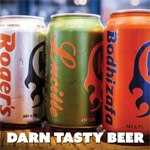
Next, the essay talks about craft beer labels. Personality, quirky mascots, puns and inside jokes, Robichaux says, were fun “until it became clutter and noise.” There’s a tiny hint of truth to the notion that craft beer risks not being taken seriously if it continues to sound too silly and too cute. Kind of. Maybe. Not. Personality and individual character are part of what sets craft beer apart from traditional, faceless, corporate beer.
In very general terms, Robichaux is right. There’s a lot of noise and the industry would benefit from a bit of restraint; however, a brewery should not sacrifice its personality for the sake of quieting the noise. Individuality is one of the things that makes craft beer cool. Every situation is different just as every brewery is different.
There are 9,000 breweries in the USA and most of them make multiple IPAs. Coming up with an original name for your new IPA is hard. In defense of the industry, Matt Gocioch of the Brewers Association suggested that, “The outlandishness of some beer names is simultaneously true and nearly unavoidable. As anyone who has gone through the exercise of trademarking a beer name knows, there are a whole lot of descriptive names already taken.”
Tallboys
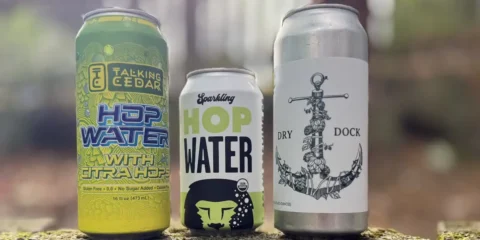
I’ve heard several people express displeasure with how frequently craft beer is packaged in four-packs of 16-oz cans. Robichaux is one of them. Other than the fact that select individuals don’t like them, I’m not sure how damaging 16-oz cans are to the industry. I don’t know if it’s a problem. The Brewers Association presented some data on the use of tallboy four-packs, but I don’t see that the data proves a point one way or the other. It seems 4x16s have a place, and so do 6x12s.
I’m not good at math, so I’ll take him at his word: 6x12s are a better value proposition. If a consumer is looking for something familiar, or something to stock the fridge, a sixer of 12-oz beers is the answer, or maybe even a 12-pack. However, if a consumer is looking for something a bit less common, maybe a limited-release beer, that’s when a four-pack of tallboys fits the bill. That’s how I see most breweries packaging their beers.
One is a staple while the other is an occasion. You stock the pantry with beans, rice, and other regular stuff you buy at Costco, but sometimes you pay a little bit more for that special tin of imported Italian tuna you buy at the boutique.
Robichaux also observed that a 16-oz can of beer won’t fit in a regular koozie. I assume he mentioned it lightheartedly. If it’s truly important to you, 16-oz koozies are available. To quote my old buddy, Pete, “Koozie? Nah, this beer ain’t gonna have a chance to get warm.”
In closing, I’ll just say that there is always room for constructive, meaningful criticism and it’s important for the craft beer industry to listen to it. That said, because this particular opinion piece was shared on such a large platform, I wish it contained more factually accurate observations.