

Quality Over Quantity, Because That’s What Matters Most
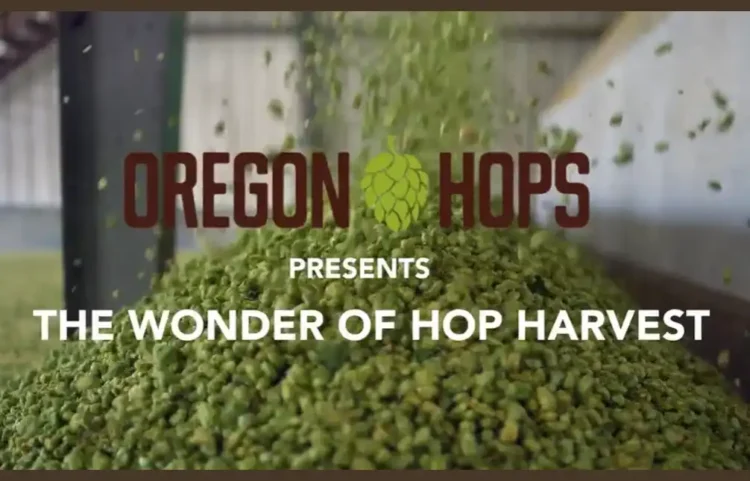
Harvest starts next week for many of Oregon’s hop growers, and by all accounts, this year is going to be a good one. After a rough few seasons of shrinking acreage alongside slipping beer sales, growers are excited about what is coming out of the ground this harvest season — not because of how much they grew, but because of how good it is.
Fresh hop beer season follows close behind the launch of harvest season, and it remains one of the more distinctly Pacific Northwest experiences in American beer: brewers picking up wet-off-the-vine hops straight from local farms and getting them into the kettle or tank within hours, rather than months. That immediacy is the whole point, and this year, growers say the timing aligns with an unusually good crop.
“After a few tough years with hop acreages declining as beer sales dipped, Oregon hop growers are especially excited about this year’s hop harvest,” said Michelle Palacios, executive director of the Oregon Hop Growers Association. “The mild spring resulted in ideal growing conditions for the hops, meaning we’re expecting great flavor and aroma.”
Palacios also pointed to the Willamette Valley’s particular terroir and its proximity to Portland — Beervana, as she called it — as the reason Oregon’s fresh hop season plays out differently than anywhere else in the country. Hops harvested in the morning can realistically be in a brewer’s kettle by afternoon. The valley’s hop farms are, in many cases, less than one hour away from Portland’s breweries.













Oregon’s fresh hop season starts earlier than Washington’s because the harvest starts earlier. Centennial, Cascade, Strata, and Sabro are among the first hop varieties to come ready each year. That’s why many of the year’s first fresh hop beers are brewed using those hop varieties procured from Oregon growers.
The Numbers
According to USDA data, Oregon growers strung 5,443 acres of hops in 2026, a modest 1.6% increase over last year. That’s good enough for third place nationally, behind Washington (30,301 acres) and Idaho (5,898 acres). So while Oregon isn’t catching up to its northern neighbor in sheer volume, the acreage held steady — a small but meaningful sign of stability after several years of double-digit acreage declines tied to a broader slump in beer sales, which are down 4% for the second year running, and perhaps some over-planting because of optimism about the future of crat beer.
Northwest Brewers enjoy a fresh-hop advantage. As in past years, the Pacific Northwest accounts for 98-99 percent of the annual crop. Brewing fresh hop beer in this part of the country is much easier because of the proximity of the hop farms.
Steady acreage paired with excellent growing conditions is really the story here: less about growth, more about quality showing up exactly when the industry could use some good news.
Why the Quality Matters
Beer is a simple product on paper — water, malt, yeast, and hops — which is exactly why the quality of those four ingredients carries so much weight. It’s like bruschetta: bread, olive oil, tomato, and cheese. It’s all about the quality of each of those simple components.
“Beer is usually only four ingredients – water, malt, yeast and hops, which makes the quality of those ingredients all the more important,” said Sam Pecoraro, brewmaster at Von Ebert Brewing and Oregon Grower Relations Ambassador for the Hop Quality Group. “We’re lucky to be in the Northwest where nearly all of America’s hops are grown. Fresh hop beer season is the perfect time to celebrate and support our local brewers and growers.”
Why It Matters Beyond the Beer
Hops aren’t just a brewing ingredient in Oregon — they’re an economic engine. The state is home to about 300 breweries, brewpubs, and taprooms, generating more than $8.9 billion in economic output and $2.8 billion in wages, and supporting 46,700 jobs statewide. That makes Oregon the fifth-most beer-job-reliant state in the country, with roughly 1 in every 633 jobs tied to the industry.
Given the tough couple of years the beer business has weathered — sales down, breweries closing, hop acreage shrinking right alongside it — a genuinely strong harvest is worth celebrating on its own. When fresh hop season kicks off in the coming weeks, that’s exactly what Northwest beer drinkers will get a chance to do.