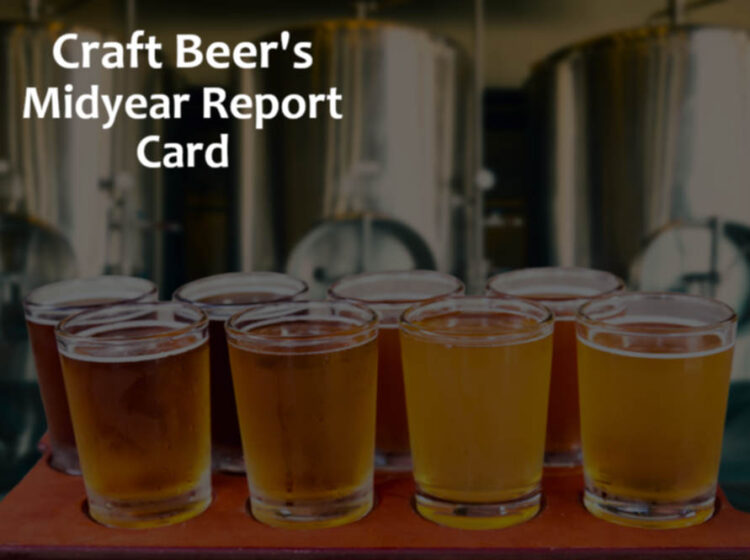



The Brewers Association (BA) shared its midyear industry survey this week. Honestly, I went in expecting bad news, the way you brace yourself for a long-overdue dentist visit. What I found instead was something closer to “it’s gonna hurt, but we can save the tooth.” I’ve gone over the BA midyear report and translated it. Let’s unpack this thing.
The Headline Numbers. The Not-So-Good News.
Craft volume was down 4% in the first half of 2026 compared to the same stretch last year. That’s not nothing, and it’s certainly not something to celebrate — but it’s roughly in line with where we’ve been living for a while now. It is not a nose-dive, so we can step off the ledge. The BA pulled this estimate from more than 600 breweries representing about a fifth of total industry volume, then adjusted for the fact that their survey sample has historically outperformed the wider industry.
Meanwhile, the number of operating breweries kept shrinking, too. There were 9,344 breweries running in June 2026, down 1.8% from 9,515 a year earlier — and that rate of decline actually ticked up slightly from where it sat in the first half of 2025. Breweries categorized as regional breweries and microbreweries took the biggest hits, down 3% each. Breweries categorized as taprooms and brewpubs endured more modest declines. Small percentages, sure, but when you’re talking about thousands of breweries, “small percentage” still means a lot of real doors closing in real towns. Real jobs lost.
The Bright Spot Hiding in the Numbers
The story gets more interesting. Taprooms were the best-performing brewery model by volume change in the first half of the year, and distributed draught actually gained market share — up half a percentage point — while packaged product and onsite sales both slipped. Translation: people are still going out, sidling up to the bar, and ordering a freshly poured pint, even as the to-go six-pack business struggles. If you needed a reason to feel good about supporting your local taproom, there it is, published in an industry report.













Here on the Beer Blog of Record, I’ve noted this stuff before. Brewery taprooms are the industry’s bright spot these days. Consider the number of stroller-pushing day-drinkers wandering the streets of Seattle’s bustling Ballard Brewery District on a Sunday afternoon. Observe the beer line at your local brewery’s weekly trivia night. Whatever else is happening with beer these days, brewery taprooms and brewpubs are still considered cool. Maybe cooler than ever.
Beer is Not Alone
Regarding things that go “beep” at the checkout counter, retail scan data actually painted a darker picture than the BA’s own numbers — NielsenIQ had craft down 5.2% off-premise, and total beer plus non-alc beer down 4%. But craft beer isn’t suffering in a vacuum. Spirits was down 5.3%. Wine really took in the shorts: wine was down a brutal 9.2% for the year ending in May, according to Wine & Spirits Wholesalers of America. Misery loves company, I suppose, and right now the entire beverage alcohol industry is huddled under the same umbrella, praying for the sun to come out again.
Growth is Never a Bad Thing
The report referenced a recent consumer poll – the annual Harris Poll Consumer Survey. Buried in the survey responses is a number you might find surprising: 54% of breweries reported growth in the first half of the year, compared to 43% reporting declines. Every single brewery type — taprooms, brewpubs, micros, regionals — had more operators growing than shrinking. Bigger breweries fared even better: 59% of the breweries that produced over 10,000 barrels reported growth. That’s up substantially from 49% reporting growth in last year’s survey.
Check this out. Another bright spot: craft drinkers are drinking more craft. Monthly consumption among craft beer fans hit 85% in this year’s BA/Harris Poll survey — up 10 points year-over-year and the highest mark since before the pandemic. Those same drinkers visited breweries 5.5 times on average over the past year, up from 5.1 the year before. To those of us living in craft beer hotbeds, like Seattle and Portland, visiting a brewery taproom just 5.5 times per year is bizarrely low, but not everyone enjoys the jolly abundance of breweries that we do.
In summary, however you slice it, the people who love this stuff are showing up more often, not less.
The Bottom Line
Nobody’s declaring that we’ve reached the bottom of this valley just yet, and the BA itself isn’t blowing sunshine — the big-picture conditions for brewers haven’t gotten any friendlier in 2026. But after a few years of every arrow pointing straight down, “the decline slowed down a little, and the people who stick around keep showing up” counts as genuinely good news in this business.
The breweries that have made it through the last few years of this grind have earned something out of it: a leaner, a more loyal footing upon which they can build a future. It’s not a comeback story yet. But it might be the first page of one. Chin up. Shoulders back. Carry on.