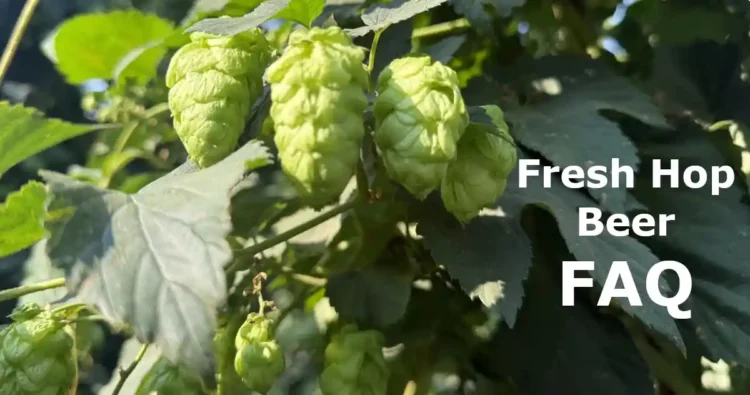


What is fresh hop beer? I’ve explained it approximately one million times, give or take a few hundred thousand. Below, I provide a Fresh Hop FAQ to help us all get it right.
There’s a certain type of beer nerd who nods knowingly the second you say “fresh hop,” the same way a self-described wine snob might nod along when someone mentions “terroir” even though they don’t know what that really means. Hey, no judgment — I’ve done it too, in other contexts, about other things. Fresh hop beer is one of those topics where a lot of people roaming taprooms, sporting their favorite brewery T-shirts and ticking boxes on Untappd, are quietly winging it. Nodding along.
I’m not talking about you, of course, but for so many other folks, fresh hop beer remains something of a mystery. I’ve fielded the questions more times than I can count, at festivals, in comment sections, at parties where I probably should have just been enjoying myself instead of giving an impromptu lecture about hop farming. And honestly? It’s a genuinely tricky thing to explain if you don’t already have some baseline understanding of how beer gets made and what hops actually do in the first place.
So let’s fix that once and for all. Bookmark this page, forward it to that one friend who keeps nodding along. Let’s stop winging it.













Fresh Hop FAQ
Fresh hop beer is made using hops that go from the field to the beer-making process within hours of harvest, rather than the dried, pelletized hops used the rest of the year. General consensus says a beer only earns the “fresh hop” title if the hops are used within 24 hours of the vines being cut from the earth. (And yes, technically, the botanical designation is “bine,” not “vine.” Feel free to bring that up at parties and make yourself sound like the smartest person in the room. Just know that if you do, you may encounter some smarty-pants, like me, who will ask you to explain the difference between a vine and a bine. Or just say vine and avoid the embarrassment.)
Basically nothing, but let’s pretend it’s complicated for a second. You might encounter both terms, so I’ll explain. Hops are normally dried within hours of picking to preserve their character for the long haul. If the hop flowers (the cones) are intercepted before that drying happens and used to make beer while still fresh off the plant, those hops are still “wet” and we call that beer a fresh hop beer, or a wet hop beer. When describing this style of beer, some brewers say “wet,” some say “fresh,” and this is one of those circular arguments that will never get resolved. All wet hop beers are fresh beers, but not all fresh hops are wet; however, the fresh hops used in fresh hop beer are both wet and fresh. I have not conducted any surveys, but I don’t think many people make a fresh hop beer with freshly picked, freshly dried, freshly processed hops. The good news is you do not need to pick a side. Fresh hop, wet hop, same beer, same yum.
Beyond the obvious answer (a hop field, duh), the hop plants are cut from the ground, pulled down from the trellises, and then immediately taken to a nearby processing facilities where fast-moving, really loud and impressive machines, separate the hop flowers (the cones) from the rest of the plant. Those cones are then immediately sent to a kiln for drying. The hops we call fresh, or wet, are intercepted before they get to the kiln. The brewery sends folks to the hop farm to do the intercepting and then return to the brewery immediately where the brew crew is waiting to put the hops to use.
Because hops, like pumpkins and your patience for pumpkin spice everything, are seasonal. They’re harvested once a year in late summer, and since brewing demands those hops be used within 24 hours of picking, the whole style lives and dies by that narrow harvest window. Not the best example, I admit, because pumpkin spice really has nothing to do with pumpkins. Fresh hop beers, on the other hand, have everything to do with hops, and they can only be made when the hops are fresh.
Harvest generally runs mid-August through early October in North America, which means fresh hop beers show up on shelves and tap lists from September through November. Basically: sweater weather, but for hops.
No, not really. Not much. Extreme heat or cold, heavy rainfall, and smoke from wildfires during the spring and summer may have an impact on the crop, but generally that stuff does not effect the timing. It might impact things like yield per acre or other agronomic stuff beer drinkers don’t really need to know about. As far as smoke goes, extreme smoke, during certain parts of the growth cycle, may effect flavor. (Not in 2026, I’m told!) But to answer the original question, with very little variation, harvest is at the same time every year.
They exist elsewhere, sure, but breweries near the hop fields have a serious home-field advantage, thanks to that pesky 24-hour rule. Nearly the entire U.S. hop crop (like, 99%) comes out of the Pacific Northwest — Washington’s Yakima Valley, Oregon’s Willamette Valley, and Idaho’s Treasure Valley. A brewery in Portland can get fresh hops and use them same-day without breaking a sweat. A brewery in Miami is, let’s say, working against considerably longer odds.
The Willamette Valley harvest typically kicks off a couple weeks ahead of Yakima’s. Some Washington breweries do source fresh hops from Oregon early, but most patiently wait their turn for the Yakima harvest, because Washington beer drinkers are famously known for their patience. (I made that last part up.)
Undried, unprocessed hops carry compounds and oils that typically get lost or altered once hops are dried and pelletized. That’s what gives fresh hop beers their distinct green, grassy, floral, herbal character — the stuff you don’t get from a bag of standard pellet hops sitting in a walk-in cooler. You get all sorts of great stuff from regular hops, just not fresh hop stuff.
Usually, yes — or at least they should. Let’s be honest. Some breweries nail this style; others phone it in. Making a genuine fresh hop beer isn’t cheap or easy, so if a brewery isn’t actually chasing real fresh hop character, you have to wonder what the point was. Marketing? Probably. But I’ll give most breweries the benefit of the doubt — I think the majority are putting in an honest effort here. Most brewers see it as a challenge and honestly want to give you a memorable fresh hop beer experience.
Not all, but most fresh hop beers are one-offs and not a repeat of last year’s beer. So the question is, are the ones produced year after year the same each year? Not necessarily. Probably not. Growing conditions, harvest timing, and other factors shift year to year, so fresh hop beers can vary from one harvest to the next. And honestly — be real with yourself — do you actually remember what last year’s Citra Slicker Fresh Hop IPA tasted like well enough to compare?
Drink it now. These beers are built for immediate gratification, not the cellar. Their delicate aromatics fade fast, so unlike styles that reward patience and aging, fresh hop beer rewards drinking it approximately five minutes after you buy it. (I made that last part up.) It might still be fine after a few weeks, but “fine” is not why you bought a fresh hop beer in the first place. Git in m’ belly!
Many are, since IPAs are a great showcase for hop character. But fresh hops show up in pale ales, lagers, and occasionally darker beers too. Personal opinion, and I’ll die on this hill: putting fresh hops into a dark, rich, malty beer is a genuine crime against humanity. Save your fresh hops for pale ales and IPAs. Maybe a pilsner, if you’re feeling adventurous. I suspect most serious beer people agree with me here.
It’s different. Not necessarily better. The hops that brewers use the rest of the year are awesome. All of your favorite IPAs use hops that have been dried and processed for preservation. Those beers are great. I think of fresh hop beer as a celebration of the season and a great way to pay homage to that magical plant. And on top of that, I like how they taste. Truth is, some people don’t like the character that a well-executed fresh hop beer offers. Weirdos.
Breweries typically announce fresh hop releases on social media and their websites once harvest season hits. Taprooms are your best bet, followed closely by good craft-focused bottleshops. Beer festivals are also a great way to sample a bunch at once without committing to a full pint of each. Speaking of which — the Washington Beer Blog is co-hosting a fresh hop festival in Seattle, October 15th through 17th 2026. Just saying.
Sometimes. It’s reasonable that it would be, given the logistics involved. But your mileage may vary — a pint might cost the same as anything else on the menu, while a 4-pack of cans might run you a bit more. This is a seasonal treat, so I’d suggest not stressing too hard over a dollar or two.
Apologies in advance; this one gets a little technical. There’s a lot of variation here. Some brewers use fresh hops solely for dry-hopping the beer during fermentation or conditioning. (Yes, I just said “dry hop” while talking about “wet hops.” Stay with me.) Other brewers toss them straight into the boil, usually near the end. Some beers are built entirely around fresh hops as the star of the show; others just fold wet hops into a broader hop bill alongside the usual pellets. However a brewer chooses to use them, if fresh hops are involved, it’s a fresh hop beer. There really are no rules beyond that. However, brewers and beer nerds will argue about what actually deserves to be called a fresh hop beer.
Whether it tastes different, or better, fresh hop beer is a celebration. It’s a way for us all to honor to that magic plant known as the hop. It’s a celebration of the season. Grain is grain, and it is really important in beer, too, but there’s something about hops that make me smile. Many beer lovers know what I’m talking about. It’s visceral. Driving through the Yakima Valley and seeing the hops climbing for the sun makes me happy. I have immense respect for the farmers (the families) that have grown hops for multiple generations, the workers who spend tireless hours in the fields from planting through harvest, the hop breeders who bring new varieties to life, and the entire industry. I’m done gushing.