

What’s Actually in Your Hop Water?
Walk into a brewery taproom these days, and you might find something different on the menu alongside IPAs and pilsners: hop water. Alcohol-free and practically calorie-free, it still promises to fix your hop jones. Many folks, especially those who are not beer-savvy, might ask, “What exactly is it?”
It’s not beer. It’s something else entirely. Hop water skips the core processes that define beer—no malted grain and, in most cases, no fermentation. At the same time, it leans heavily on the hop knowledge and production methods breweries have spent years perfecting. Here’s how hop water actually comes together and what else you should know.
What Hop Water Actually Is
- In simple terms, hop water is carbonated water infused with hop compounds that provide the hop flavor and aroma beer lovers crave, without all the other characteristics that come along with, say, a tasty IPA. Floral, herbal, fruity, citrusy, dank, resinous, piney, and so on. Any one of those adjectives, or any combination, might describe a particular hop water.
- It is gluten-free.
- Most versions land at 0 to 10 calories.
- Hop water is 0.0% ABV, though a few live in the sub-0.5% “non-alcoholic” range due to trace fermentation or hop oil content.
- Beyond that, the category is fairly loosely defined, which is part of why hop waters from two different breweries can taste nothing alike. Just like beer, it’s an opportunity for the brewery to express its unique identity.
- In most cases, breweries don’t share many details about their methods. That’s kind of cool. A little mystery keeps the romance alive.
The Starting Point: Water Quality
Any good brewery monitors and adjusts its water chemistry as a matter of routine, but with hop water, it matters even more. In a standard brew, malt sweetness and the boil itself can mask minor off-flavors in the water. Hop water doesn’t have that luxury — there’s nothing to hide behind. The filtration and mineral adjustments breweries already do for their beer matter even more. Water pH is critical, too.





Getting Hop Flavor Without Brewing Beer
Breweries generally land on one of a few approaches:
Dry-hopping style infusion. This is the most common method among Pacific Northwest producers, and it borrows directly from a technique brewers already know very well. Whole-cone or pelletized hops are steeped in water, the same way they’d be dry-hopped into a finished beer. This extracts aroma and flavor without pulling in bitterness. It’s akin to making tea with a tea bag.
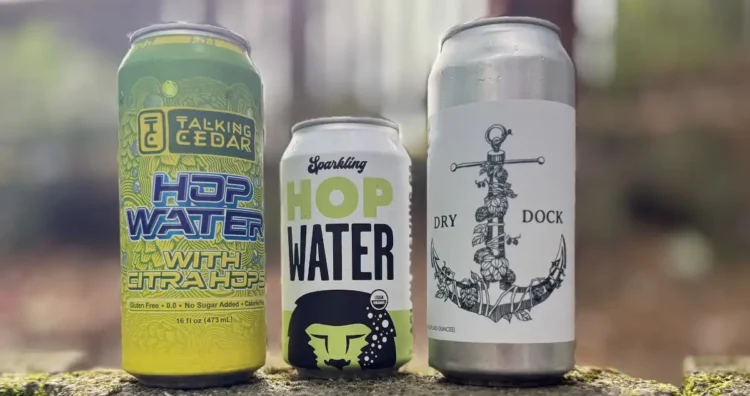
Bellingham’s Aslan Brewing makes its Sparkling Hop Water this way, steeping organic whole-cone Cascade and Chinook (and in some batches, Simcoe) hops directly into the water. The result, true to the hop varieties used, comes through as citrus and floral notes with a light, pleasant bitterness on the finish. (Pictured above: center.)
Hop extract or concentrate. Rather than steeping raw plant matter, some producers use hop oils or liquid hop concentrates engineered specifically for beverage use. These extracts provide lupulin-derived aromatics and flavor compounds while leaving behind the vegetal matter that might require filtering. They also offer something raw hops can’t always guarantee: consistency. A liquid extract measured by the milliliter behaves the same way in batch 50 as it did in batch one.
Industry suppliers have noticed the trend. Flavor science company Abstrax recently released a technical guide to help breweries build hop water programs around its hop-derived beverage products, pitching it as a way to extend existing production capability into a new, non-alcoholic category.
In 2024, John I. Haas, the world’s largest hop supplier, introduced its Euphorics™ line of products, a hop-oil-based, water-soluble flavor solution formulated to make it easy to elevate hop character and deliver impactful, natural-tasting fruit and other flavor expressions. Euphorics was designed for beer, but it also works very well for hop water.
A hybrid approach. Some producers split the difference, steeping raw hops for the base character and then using a small amount of an innovative, new, hop-derived product to round out the flavor profile.
One thing breweries generally agree on: boiling the hops is off the table. A boil pulls iso-alpha acids and real bitterness from the hops. That would make hop water taste more like a de-alcoholized beer, which is not the goal.
Hop Selection and Extraction Method
As in a hop-forward IPA, the hop varieties the brewery uses do most of the flavor work in hop water. Citra brings citrus, Simcoe leans piney, Mosaic goes tropical, and so on. Breweries often market hop water flavor profiles with the same descriptors they use for an IPA. Aslan’s Chinook and Cascade combination, for instance, produces the same herbal, citrus-forward character those hops are known for in beer.
The raw-hops-versus-extract question is also becoming a quiet point of differentiation in the category. Whole-cone or pelletized hops steeped directly in water tend to get marketed as “real hops, no extract,” appealing to drinkers who want the product to mirror traditional brewing as closely as possible. Liquid extracts and distilled hop oils, on the other hand, give larger-scale producers precise, repeatable dosing and a longer shelf life, without needing to filter spent hop matter out of the final product. Neither approach is right or wrong.
Hop extracts, hop oils, and hop-derived products in general have come a long way. The science and the processes have improved, and the brewing industry no longer talks about these products with the same chagrin it did, say, 20 years ago.
Carbonation and Packaging
Hop water is almost always force-carbonated after the hopping step. From there it goes into kegs or cans, where oxygen exposure becomes the main enemy of hop flavor, much like it is for a tasty IPA. That means hop water, like any hop-forward beer, has a shelf-life. It’s not critical, and hop water probably won’t go bad, but hop flavor compounds are, by nature, volatile little beasts. Keep hop water refrigerated and don’t let it sit around for too long.
Does Fermentation Ever Happen?
Technically, yes, in some cases. A handful of producers run a very brief or minimal fermentation step as part of their process, which can nudge the final ABV up slightly above true 0.0%. That distinction matters for labeling purposes — the difference between “0.0% ABV” and “non-alcoholic” isn’t always a marketing choice; sometimes it’s a legal one, even if there is only an infinitesimal trace of alcohol.
Why Breweries Are Making It
The business case writes itself. Breweries already have relationships with hop suppliers, know a lot about hops, have the necessary equipment, and have customer trust — hop water lets them expand into the semi-sober and non-alcoholic space without building an entirely separate production line. It’s also a straightforward way to compete for shelf space and taproom attention against sodas and other non-alcoholic drinks.
A Note on Proprietary Processes
I’ll say it plainly: most breweries are not eager to hand over their exact hop water recipe. Beyond, perhaps, the hop varieties used, things like steeping times, hop ratios, water chemistry adjustments, and whether (or how much) extract gets blended in are treated the same way a brewery treats its flagship IPA recipe—as proprietary information. So when you read “house-made hop water” on a menu, that phrase should offer all the description you need, because it might be all you get. It usually means the specifics stop there, and the rest is the brewery’s business. Again, let the mystery keep the romance fresh.
Sum it Up
Hop water isn’t a watered-down beer substitute. It’s its own category, built from a brewery’s hop expertise but following its own rules. Whether a brewery steeps whole cones the old-fashioned way or leans on a modern hop extract, the goal is the same: capture what makes hops interesting without including a drop of alcohol. Skip the calories, skip the gluten, and enjoy the hoppy goodness guilt-free. Generally speaking, no breweries are just phoning it in. A brewery’s hop water has real intention and effort behind it, and that alone makes it worth experiencing.
Want us to share your news here on the Washington Beer Blog? Click here to learn how to reach us.