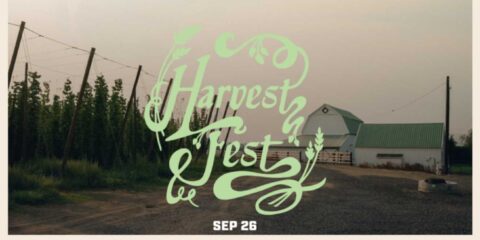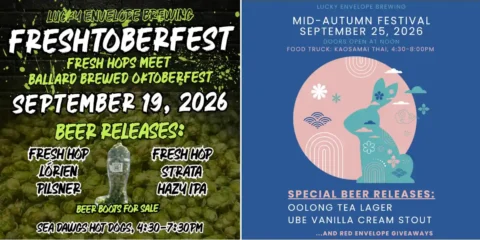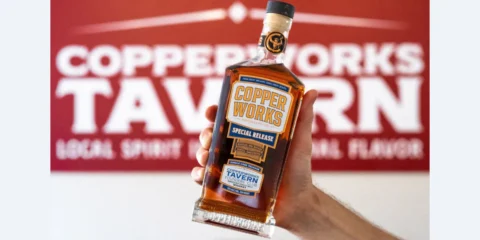
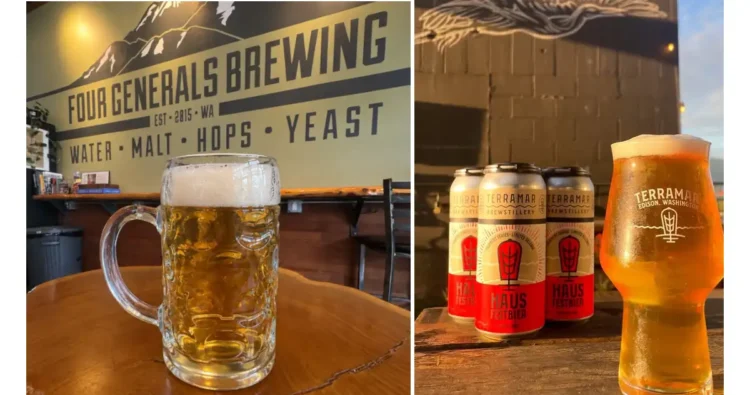
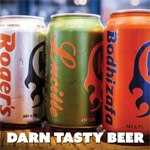
Not long ago, craft-brewed lagers were rare in the USA. That’s changed. Today, damn near every brewery produces various styles of lager, and the list includes Festbier. The upcoming Harvest Fest in Seattle on September 26th, presented by the Washington Brewers Guild, will showcase the full beer bounty of Washington, and that includes Festbier. Craft brewers across the Pacific Northwest have upped their game when it comes to this style, assisted in part by the availability of the high quality grains that make a good Festbier really shine. If you’re not yet, it’s time to get familiar with this style of beer. (Above: two of my favorite, locally brewed Festbiers.)
So, is Festbier an actual beer style, or just a catch-all term for beers brewed for Oktoberfest season? Short answer: yes. It’s both of those things. But it shouldn’t be. Let me explain.
Excellent examples of Washington-brewed Festbier
This style owes much of its character to the quality of the malted barley used to brew it. Here are two of my favorite local examples of the style, each lends special, though slightly different, attention to the grain.
—Four Generals Brewing in Renton ,Washington, is an award-winning brewer of authentic German-style beers. To brew its Festbier, brewmaster Ross uses malted barley imported from Germany (BESTMALZ). Four Generals hosts its Oktoberfest celebration this Saturday, September 19th (starting at 3 pm). That’s a great opportunity to get into one of my favorite Festbiers.
—Terramar Brewstillery in Bow, Washington, serves up its Haus Festbier as a matter of course. The brewery uses nothing but Washington-grown malted barley in all of its beer (LINC Malt and Cold Stream Malt). Laze away the hours in the Terramar beer garden with a lovely “house beer” in hand; always a great way to spend the day.
How Festbier Became Oktoberfest’s Best-Kept Not-So-Secret
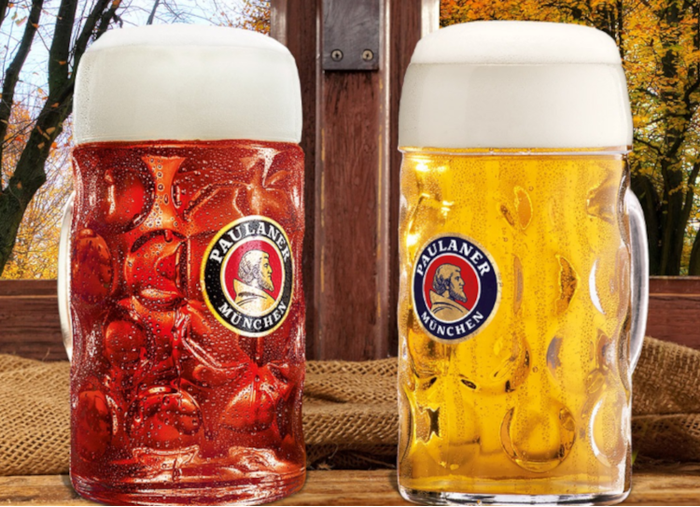
Festbier has nothing to do with Oktoberfest and it also has everything to do with Oktoberfest. This time of year, things show up on tap lists and in the beer aisles labeled as Festbier, Oktoberfestbier, Oktoberfest Märzen, Oktoberfest Lager, or any mashup of those words. Order two “Oktoberfest” beers and they might look and taste wildly different. Even esteemed German brewers like Paulaner offer two vastly different beers that say Oktoberfest on the label.


So what gives? Let’s break down Festbier, Märzen, and Oktoberfestbier — what they are, how they relate, and where they differ — so you can track down the festival beer you actually want. Because I think the one most American craft beer consumers want is Festbier.
TL;DR
- Märzen — the historic Oktoberfest beer. Amber, malty, toasty, dry finish. What most, but not all, American “Oktoberfest” beers are modeled on.
- Festbier (Fest Bier) — the modern Oktoberfest beer. Golden, clean, lighter-bodied, built for drinking by the liter. What Munich’s breweries actually serve at Oktoberfest today.
- Oktoberfestbier — a legal designation, not a flavor profile. Only six Munich breweries can use the name. It is what they pour under those big tents: Festbier.
- Oktoberfest Märzen Festbier Lager — something I just made up to illustrate my point.
Märzen: The OG Oktoberfest Beer
Märzen (German for “March”) got its name the old-fashioned way: it was brewed in March, stored it in dark, cool cellars or caves all summer, and by autumn, it was ready. The beer of choice at harvest festivals. It was the beer served at the very first Oktoberfest, a public celebration in 1810 marking the marriage of Crown Prince Ludwig of Bavaria (soon to be King Ludwig I). For the next 150 years, if you were drinking at Oktoberfest, you were drinking Märzen. It’s not what you’d drink there today.

It’s still what runs through my head when I see “Oktoberfest” on a label: amber-red, malty, a little sweet up front, dry on the finish. In other words, Märzen. It’s the style most American brewers, but not all, are chasing when they slap the word “Oktoberfest” on anything. Most stateside versions land between 5.5 and 6.5 percent ABV.
Festbier: The Beer That Replaced It
Here’s where it gets confusing: Munich’s breweries don’t actually serve Märzen at Oktoberfest anymore. Starting in the 1970s, the city’s six festival breweries began quietly swapping their Märzen-style beers for something more quaffable. By the 1990s, Festbier was the norm. Today, the word “Oktoberfest” relates to two things: the big beer festival in Munich and a style of beer that is not served at that festival.
The Beer Judging Certification Program (BJCP) defines the Festbier as follows. Overall Impression: A smooth, clean, pale German lager with a moderately strong malty flavor and a light hop character. Deftly balances strength and drinkability, with a palate impression and finish that encourages drinking. Showcases elegant German malt flavors without becoming too heavy or filling. Appearance: Deep yellow to deep gold color; should not have amber hues. Bright clarity. Persistent white to off-white foam stand. Most commercial examples are medium gold in color.
Compared to Märzen, these new offerings were less intensely malty — pale, golden lagers with a cleaner, crisper finish, thanks to the use of lighter malts and the extra hop character that balances out the sweetness. Festbier is golden, not amber. Lighter, not as sweet. Built specifically for the festival grounds, which is how they earned the name Festbier. Most clock in around 6 percent ABV.
For beer drinkers in the United States, Festbier is more approachable — much closer to what American drinkers would call a Helles. Or an adjacent, less common style called Dortmunder. Most of the Festbier I run into locally, brewed in the Pacific Northwest, tends to be a bit more robust than a true Helles, if nowhere near as malt-forward as a Märzen. Bottom line: a proper Festbier should be gold, not amber, and lighter on malty sweetness than a Märzen. No guarantees, though — your mileage may vary from brewery to brewery.
Oktoberfestbier: Like Champagne, Only Different
Then there’s Oktoberfestbier — less a flavor profile than a legal, or regional, designation. Think of it as the Champagne of beer. Sorry, Miller High Life. Only six breweries within Munich city limits are allowed to pour on the festival grounds and use the name Oktoberfestbier: Hofbräu, Augustiner, Löwenbräu, Paulaner, Spaten, and Hacker-Pschorr. These days, what they’re pouring is a Festbier. So “Oktoberfestbier” and “Festbier” are, for all practical purposes, the same golden lager — the former is a protected designation, the latter a style category.
Why This Confuses People in the U.S.
Stateside, we don’t play by Munich’s rules, and that’s where things get muddled. American breweries are free to call anything “Oktoberfest,” and most, but not all, mean the old-school amber Märzen: rich, toasty, higher gravity. Meanwhile, actual German imports labeled “Oktoberfest” on U.S. shelves are often the modern golden Festbier, since that’s what’s actually poured in Munich these days. So you might end up comparing two beers that share a season and a name but sit at opposite ends of the style spectrum — an American “Oktoberfest” that’s amber and malty next to a German one that’s golden and crisp.
The key thing to remember about Festbier: It isn’t supposed to be Märzen. It’s supposed to land closer to Helles — lighter, brighter, golden, more drinkable. Not quite as light as a true Helles in my experience, but nowhere near Märzen territory either. No guarantees, though. Life is like a box of chocolates, and so is beer: you never know what you’re going to get. But hand me an amber-colored, malty-sweet Festbier and I’ll be disappointed.
Great American Beer Festival Representation
Like I said, more and more U.S. craft breweries are making lager style beers these days. To gauge that, consider the number of entries at the Great American Beer Festival, one of the biggest beer judging events in the world, in the two style categories that address the beers we are talking about:
- In 2015, 65 beers were entered in the German-Style Maerzen category (Märzen).
- In 2025, 161 entries in the German-Style Maerzen category.
- In 2015, 48 beers were entered in the Dortmunder or German-Style Oktoberfest category (Festbier).
- In 2025, 186 entries in the Dortmunder or German-Style Oktoberfest category.
- Dortmunder? Read my quick lesson about Dortmunder here.
You shouldn’t have too much trouble finding a Festbier in the USA these days, especially this time of year when Oktoberfest is on everyone’s minds. It’s great any time of year, but its history is tied to the autumn. Find some and drink it now.